
Striped bass treble hooks vs single hooks Gaspe peninsula - fishing guide Gaspesie
Adult Striped Bars in Chaleur Bay
Many schools of adult Striped Bass head to Chaleur Bay after their breeding season to find food. They feed on whatever they can find, such as sand eels, mackerel, capelin, herring, lobster and more. They will spend the summer in the bay, feasting on this abundant food while traveling hundreds of kilometers along the coast. The slightly warmer water of the bay is very attractive to many species, and sea bass benefit from it too.

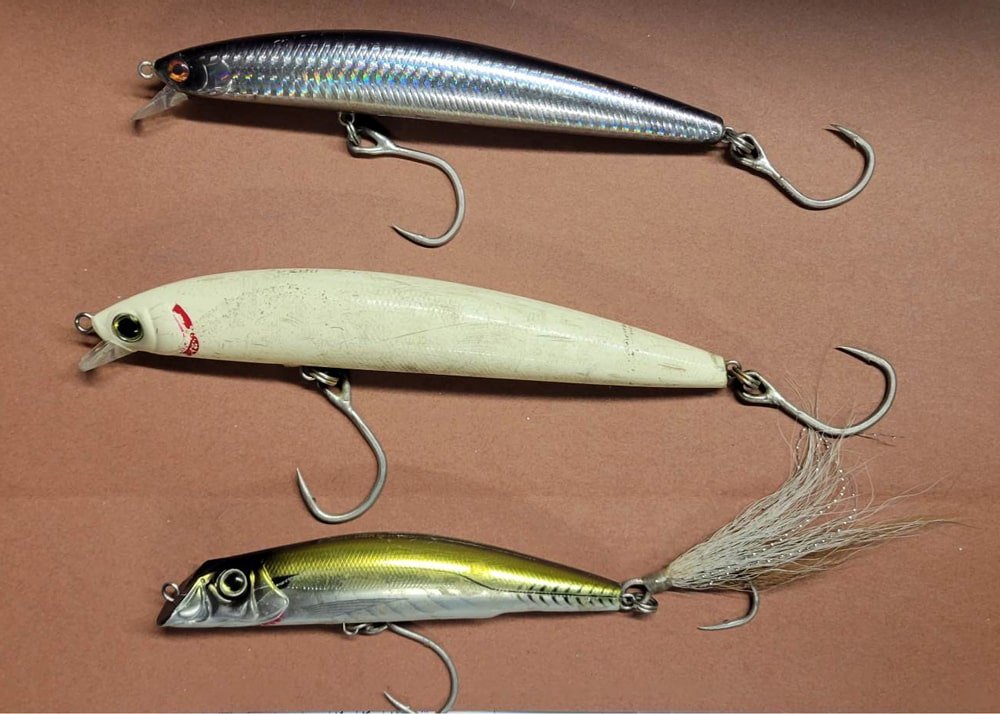
To make things easier for you, we've drawn up a conversion chart allowing you to replace treble hooks with single hooks for hard lures.
Please note that from one company to another, hook sizes for the same number can vary by several millimetres, which is why we've drawn up an equivalence chart to help you choose the right hook for you.
To find out the right size, simply measure the distance between the two points of your treble hooks (tripod) and refer to the table to find the equivalent in the single hook version.

Fry survival
Fry that make it through their first year have a very good chance of reproducing when the time comes. However, many factors come into play, and some seasons are more productive than others. In short, sea bass migration and spawning are essential to the survival of this species.
Mature fry and their life at sea
Mature fry then leave the Miramichi for the Gulf of St. Lawrence, where they scatter along the coast in search of food. Some will swim north towards the Gaspé Peninsula, Chaleur Bay. Others will head south from Prince Edward Island to the tip of Cape Breton Island in Nova Scotia. They become fierce predators and play a key role in the Gulf's marine ecosystem. They will spend around 3 years at sea facing adversity before finally returning to the fold. However, this will only be when they have reached maturity and the ability to reproduce. Adults will make long voyages throughout their life cycle, which averages 20-25 years in our northern waters, and they will reproduce several times throughout their mature years.
Adult Striped Bars in Chaleur Bay
Many schools of adult Striped Bass head to Chaleur Bay after their breeding season to find food. They feed on whatever they can find, such as sand eels, mackerel, capelin, herring, lobster and more. They will spend the summer in the bay, feasting on this abundant food while traveling hundreds of kilometers along the coast. The slightly warmer water of the bay is very attractive to many species, and sea bass benefit from it too.

Striped bass movements along the coast
Some shoals of Striped Bass move up the Gaspé Peninsula towards the Gulf Estuary, following the warm currents. They make their way to the Rimouski area, where they meet and cross paths with the "new" St. Lawrence Striped Bass population, which has recently been successfully reintroduced. When conditions permit and ocean currents are favorable, they even cross to the north coast, where in 2017, for example, catches were common all along the coast in areas that previously had no trace of Striped Bass. It's highly likely that the bass visiting the north coast and the Saguenay are a mixture of the two populations; future studies will determine this more precisely.
The return of the striped bass to the mouth of the Miramichi River: a fragile species
At the end of the summer season, when the water temperature begins to drop and the days start to shorten, the signal is given. Much like migratory birds, many bass will leave the Gulf Estuary to return to the mouth of the Miramichi River. Some fish are already making their way up the river in autumn, but some won't have time to get there and will spend the winter in the mouths of smaller rivers where the water temperature is slightly warmer than that of the sea, while others remain trapped and die at sea... Our striped bass populations are at the northern limit of the species' distribution, and unfortunately our bass sometimes pay the price of living in very cold waters, not surviving the harsh winters.
The decline of the striped bass population: causes and consequences.
Several factors can affect the reproduction rate, and humans have a major influence on the living environment of this fish, partly due to the simple fact that it spends its life close to the coast, close to us... Not to mention the fact that they reproduce in rivers that require specific conditions for the development of eggs and fry. These conditions vary greatly from year to year. For example, at one of the last population assessments of striped bass in the Miramichi in 2018, the population had shrunk by a third compared to 2017 (from 900,000 to 333,000), marking the first reduction in a steady growth for more than a decade. However, DFO says there is a large margin of error on these figures in their reports, but the situation is worrying nonetheless. Striped bass are ferocious predators as adults, and a real boon for sport fishermen. Schools roam the coasts like a pack of wolves in the mountains in search of easy prey. It has been contributing to the marine balance of the North American east coast for thousands of years, and we have the opportunity to cross swords with this fish in an absolutely incredible setting on Quebec's east coast. It's important to emphasize the value of the economic spin-offs from fishing this fish, but above all the value it has when it's alive, healthy and reproducing.
The fragile balance of this fish's life cycle can change rapidly. As we saw with the St. Lawrence River population, which in the late 1960s completely disappeared in just 10 years. Seaway excavation work in the Île d'Orléans area, combined with an abundance of pollutants in the breeding and fry rearing areas, led to the extermination of the St. Lawrence population - a man-made extermination.
Success of the striped bass reintroduction program in Quebec
A striped bass reintroduction program was set up in Quebec in collaboration with the federal Department of Fisheries and Oceans in the early 2000s, with the aim of trying to reintroduce the extinct species into the current ecosystem. So far, the program has been a great success... The seeded bass were taken from the Miramichi River, developed in fish farms, and to date, 6.5 million bass of various sizes (mostly fry) have been seeded. The river's water quality has greatly improved since then, and the dredging of the seaway is carried out differently. In a way, we've developed an ecological conscience, but there's such a fine line between the environment and economic development. We shouldn't take it for granted that the sea bass is back for good, as many questions remain unanswered and further study is sorely needed. The future is certainly brighter than it was for the St. Lawrence sea bass, and sport fishermen will soon be able to enjoy the fruits of the reintroduction of a "new" species that is absolutely fascinating to catch.
The growing popularity of Striped Bass in the sport fishing world of the Gaspe peninsula
A striped bass reintroduction program was set up in Quebec in collaboration with the federal Department of Fisheries and Oceans in the early 2000s, with the aim of trying to reintroduce the extinct species into the current ecosystem. So far, the program has been a great success... The seeded bass were taken from the Miramichi River, developed in fish farms, and to date, 6.5 million bass of various sizes (mostly fry) have been seeded. The river's water quality has greatly improved since then, and the dredging of the seaway is carried out differently. In a way, we've developed an ecological conscience, but there's such a fine line between the environment and economic development.
We mustn't take it for granted that the bass has returned for good, as many questions remain unanswered and more in-depth studies are sorely needed. The future is certainly brighter than it was for the St. Lawrence sea bass, and sport fishermen will soon be able to enjoy the fruits of the reintroduction of a "new" species that is absolutely fascinating to catch.